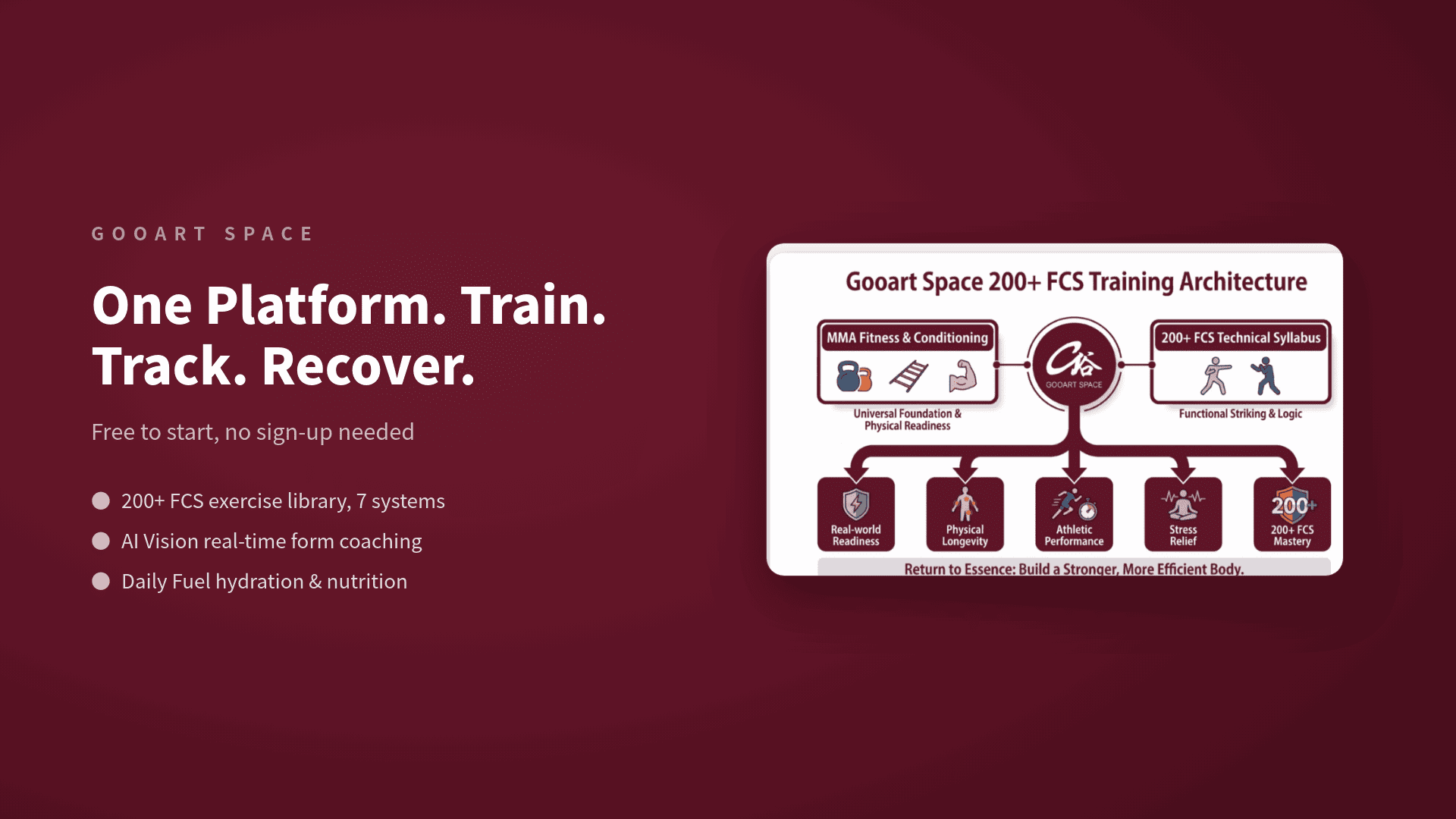

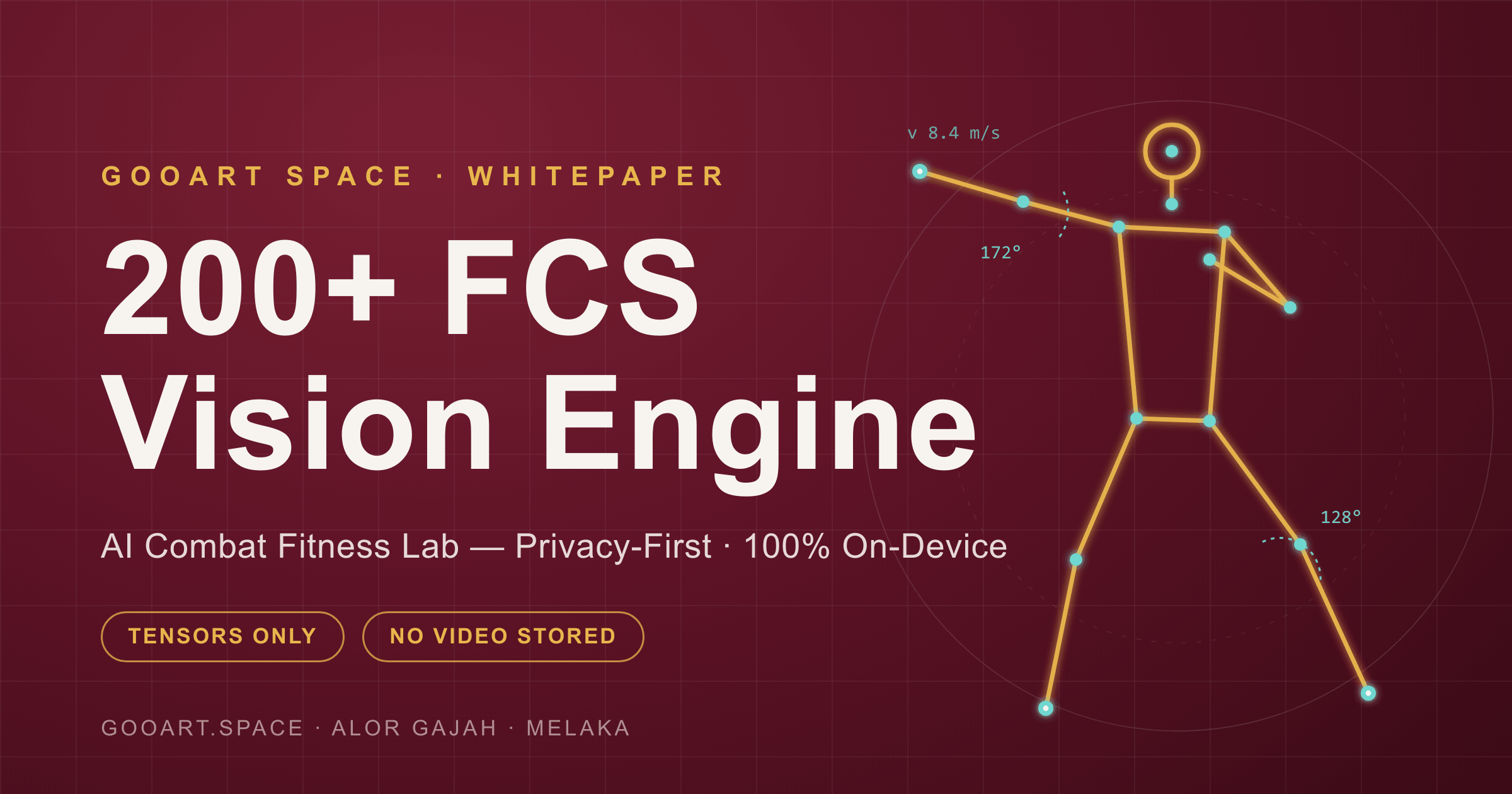
FCS Whitepaper v3.10 — Founding Phase Edition
The Gooart Space 200+ FCS Whitepaper documents how a 100% on-device AI Vision engine powers a 200+ movement functional combat training system — no video recording, no cloud storage, ever. This whitepaper (v3.10, Founding Phase Edition) covers the founding membership model, a review of commercial AI-fitness hardware already sold abroad, and the technical reasoning behind our motion-capture stack.
What’s Inside
- Founding Phase & Privacy — the “Tensors Only” data policy behind the 10 founding member spots in Tebong/Tampin.
- Commercial Reality Abroad — how Peloton Guide, Tempo, Tonal 2, FightCamp, and Kemtai already price AI-assisted coaching hardware overseas, with sourced price anchors as of July 2026.
- Global Motion-Capture Landscape — a side-by-side of optical motion capture (Vicon, OptiTrack), wearable IMU systems (Xsens, Noitom), and pure computer-vision pipelines (OpenPose, AlphaPose, HRNet), explaining why we standardized on MediaPipe running fully client-side in the browser.
Why Pure Computer Vision in AI Martial Arts
Optical motion capture and wearable IMU rigs deliver lab-grade accuracy but require dedicated hardware, calibration, and often a technician on-site — impractical for a home or small-gym setting. For a seamless AI martial arts experience, a browser-based, MediaPipe-driven pipeline runs entirely on the user’s own device, so no footage ever leaves the browser. That single constraint — Tensors Only, never video — shaped every engineering decision documented in this FCS Whitepaper.
Why Founding Members Get a Different Deal
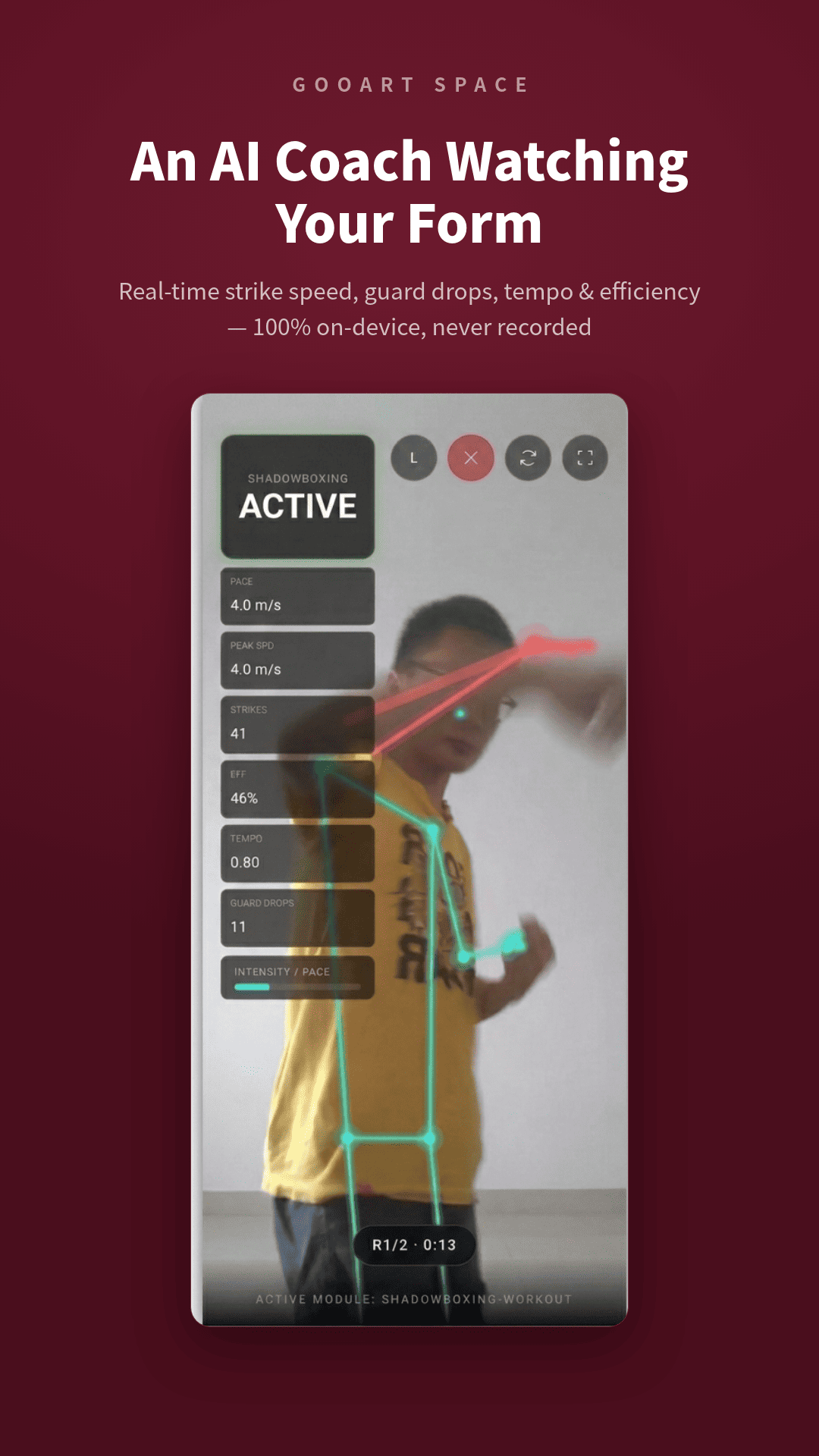
Every frame from your camera is processed entirely inside the browser — turned into pose-landmark coordinates (a tensor of joint positions) and immediately discarded. No video frame is ever uploaded, transmitted, or written to disk.
Most fitness apps that use camera-based form-checking take the opposite approach: they record and store workout video for progress review, coaching QA, or model retraining, which quietly turns every session into a growing video archive. That’s the gap the “Tensors Only” architecture is built to close.
Because granting camera access with zero video retention asks for a different kind of trust, the 10 founding member spots in Tebong/Tampin exist specifically to validate that model in the real world before it’s opened more broadly — founding members get lifetime founding pricing and a direct line to shape the next features in exchange for training on an unproven-at-scale, but architecturally more private, system.
What Similar Products Cost Elsewhere
This FCS Whitepaper compares what similar AI-coached training systems already cost abroad, because context matters when judging a fair price point. Peloton Guide launched at $295 in hardware plus a $24/month Guide Membership — and was discounted down to $95 before being pulled from sale in 2026, a sign that hardware-plus-camera AI coaching struggled to sustain itself even at Peloton’s scale.
Tempo’s AI-guided strength training starts at $39/month (dropping to $35 or $30/month on 12- or 24-month terms). Tonal 2 sits at the premium end: $4,295 MSRP plus a mandatory $59.95/month membership for the first year.
FightCamp, the closest AI boxing comparison, spans $299–$899 in hardware packages plus $39/month (or $14.99/month for tracking-only). Kemtai — a browser-based computer-vision platform with no wearables or sensors, architecturally the closest peer to 200+ FCS — sells almost entirely through enterprise and clinical contracts rather than public consumer pricing.
Across this landscape, the products still standing lean on browser-based computer vision instead of dedicated cameras or wearables — the same direction 200+ FCS takes.
Global Motion-Capture Landscape
Optical marker-based systems like Vicon and OptiTrack deliver sub-millimeter accuracy but require multi-camera studio rigs, careful calibration, and five- to six-figure setup costs — built for film and sports-science labs, not a home or small studio.
Wearable IMU suits like Xsens and Noitom skip the cameras entirely, but drift accumulates over long sessions, and fitting, charging, and laundering a suit for every member doesn’t scale.
Pure computer-vision pipelines took a different path: the OpenPose, AlphaPose, and HRNet research lineage matured into production-grade, on-device runtimes like MediaPipe, capable of full-body pose estimation inside a standard mobile browser at real-time frame rates with no extra hardware.
That maturity curve — accuracy finally catching up to convenience — is what makes a 100% on-device, browser-only motion-capture stack commercially viable in 2026 in a way it wasn’t five years ago.
No stored video. No dedicated hardware. Browser-native computer vision. Those three constraints are what separate 200+ FCS from every commercial alternative reviewed in this FCS Whitepaper — and the 10 founding member spots in Tebong/Tampin are the first real-world test of whether that model holds up outside a lab.