

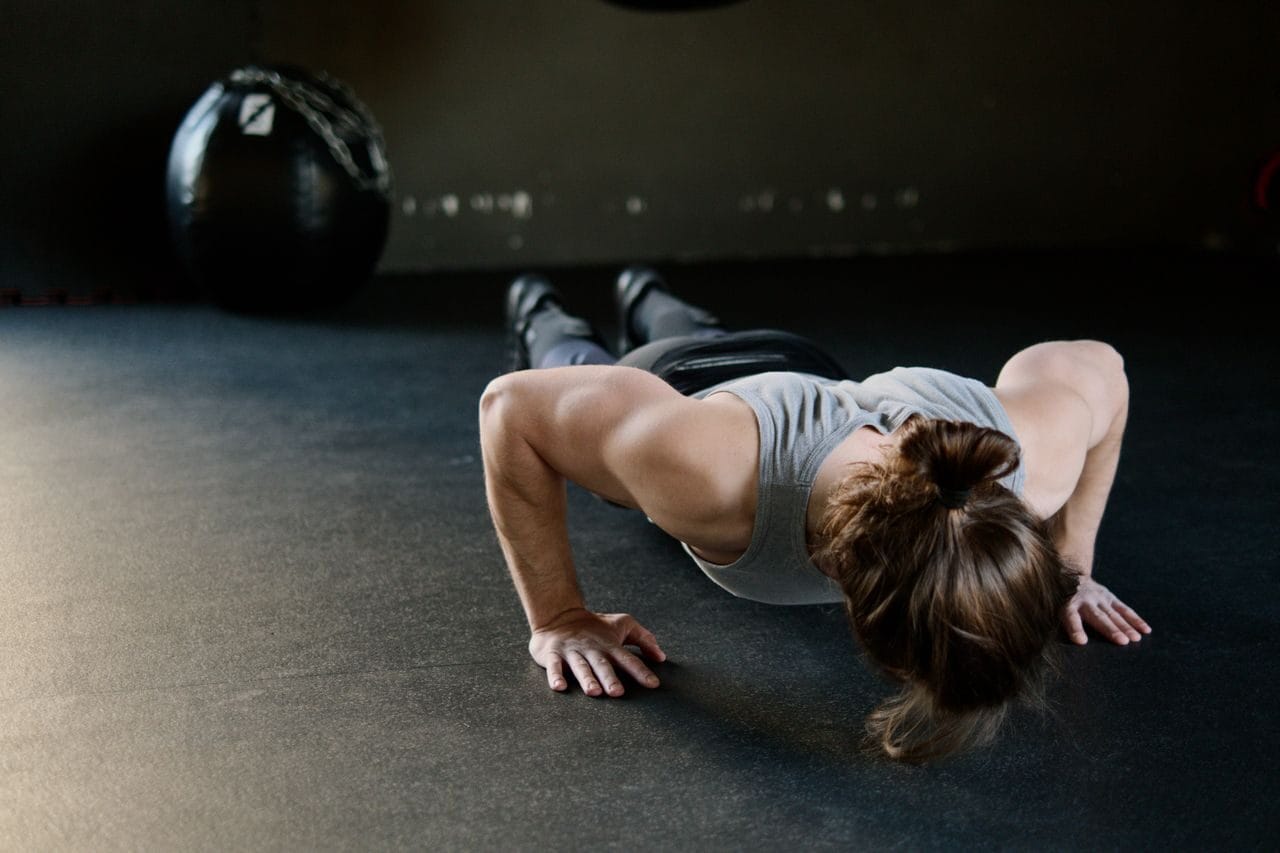
The bench press is the most-missed piece of gym equipment — and the least necessary. Your chest does not know what a bench is; it knows horizontal pushing against resistance, and a home workout chest plan built on push-up progressions delivers exactly that. This guide gives you the coach’s version: the variations that matter, a 20-minute session, and how to hit the lower chest without a decline bench.
Table of Contents

What Actually Builds a Chest at Home
The push-up is the bench press you carry everywhere. The muscle-building variables — load, range, effort near failure — can all be adjusted with body angle, tempo, and pauses instead of plates. The progression rule is simple: when a variation stops being hard at 15 clean reps, move to a harder one.
Home Workout Chest Essentials: The Push-Up Ladder
Climb these four rungs in order. Stay on each until it is genuinely easy:
- Incline push-up (hands on a table or bench) — the entry point; builds the groove and the brace.
- Standard push-up — full range, chest to floor, no half reps.
- Tempo push-up — three seconds down, one-second pause, drive up. Same exercise, double the stimulus.
- Decline push-up (feet on a chair) — more load on the upper chest and shoulders.

If you own a pair of dumbbells, the dumbbell floor press belongs in the rotation too — the floor limits the range to a shoulder-friendly arc and lets you add real load.
Chest Home Workout: The 20-Minute Session
Run this two to three times per week:
- Block 1 (strength): your current ladder rung — 4 sets to 2 reps short of failure, 90 seconds rest.
- Block 2 (volume): one rung easier — 2 sets of controlled tempo reps.
- Finisher: incline push-ups to a clean technical stop, rest 60 seconds, repeat once.
Progress by moving up the ladder first, adding sets second. Write the numbers down — the session you cannot measure is the session you cannot progress.
Home Workout Lower Chest: The Decline Angle
To bias the lower chest without a decline bench, flip the angle: push-ups with your hands elevated on a chair or step shift emphasis toward the lower fibres, as do chair dips with a slight forward lean. Two sets of either, once or twice a week, is all the specialization a home trainee needs.
Common Mistakes
- Half range. Chest to the floor or it does not count. Shortened reps shorten results.
- Flared elbows at 90 degrees. Keep elbows roughly 45 degrees from the torso — shoulders will thank you.
- Daily max-effort sets. The chest is a muscle, not a streak to protect. Rest days are when it grows.
- Speed reps. Bouncing off the floor trades tension for momentum.
FAQ
Can you build a chest with push-ups only?
Yes — if you progress the variations and take sets close to failure. The chest responds to effort and load, not to the brand of the bench.
How many push-ups should I do in a session?
Total quality volume matters more than any single set: roughly 40–80 hard reps across the session, split into sets that stop 2 reps before failure.
How often should I train chest at home?
Two to three times per week with at least one rest day between. More is not better; recovered is better.
Are wide push-ups better for chest?
Slightly more chest, less triceps — but harder on shoulders. Standard width with full range is the better default.
When should I add weight?
When tempo decline push-ups feel easy for 15+ reps, a loaded backpack or dumbbell floor presses are the next step up the ladder.
Press On
Twenty minutes, two or three times a week, one honest ladder. Build the push here and it carries into everything overhead and forward — the functional training workout blueprint shows where chest work fits the full-body picture, and the free My Training library has every execution page you need.

Lifetime Training Profile – Permanent 200+ FCS Access
Ready to track your progressive overload across all pushing and core patterns? Unlock your lifetime personal training dashboard with real-time AI Vision form corrections, 1RM tracking, and permanent access to 200+ FCS combat drills.
You've read the standards — now train them. Book a 1-on-1 session at our Melaka studio and get your baseline mapped across all 7 FCS systems in your first hour.
Book Your First Session