

Side Plank is a beginner core-stability drill inside the 200+ Functional Combat System (FCS), working primarily the lateral core — the obliques and the deep muscles that stop your trunk from tipping sideways. It is programmed as a main-workout element, trained solo. Equipment needed: nothing but your bodyweight and a mat.
The side planks exercise is the simplest anti-side-flexion test we own: one elbow, one straight line, and gravity doing honest work. Where crunches train the core to move, the side plank trains it to refuse movement — the exact quality that keeps a fighter upright when a kick crashes into the guard.
Table of Contents
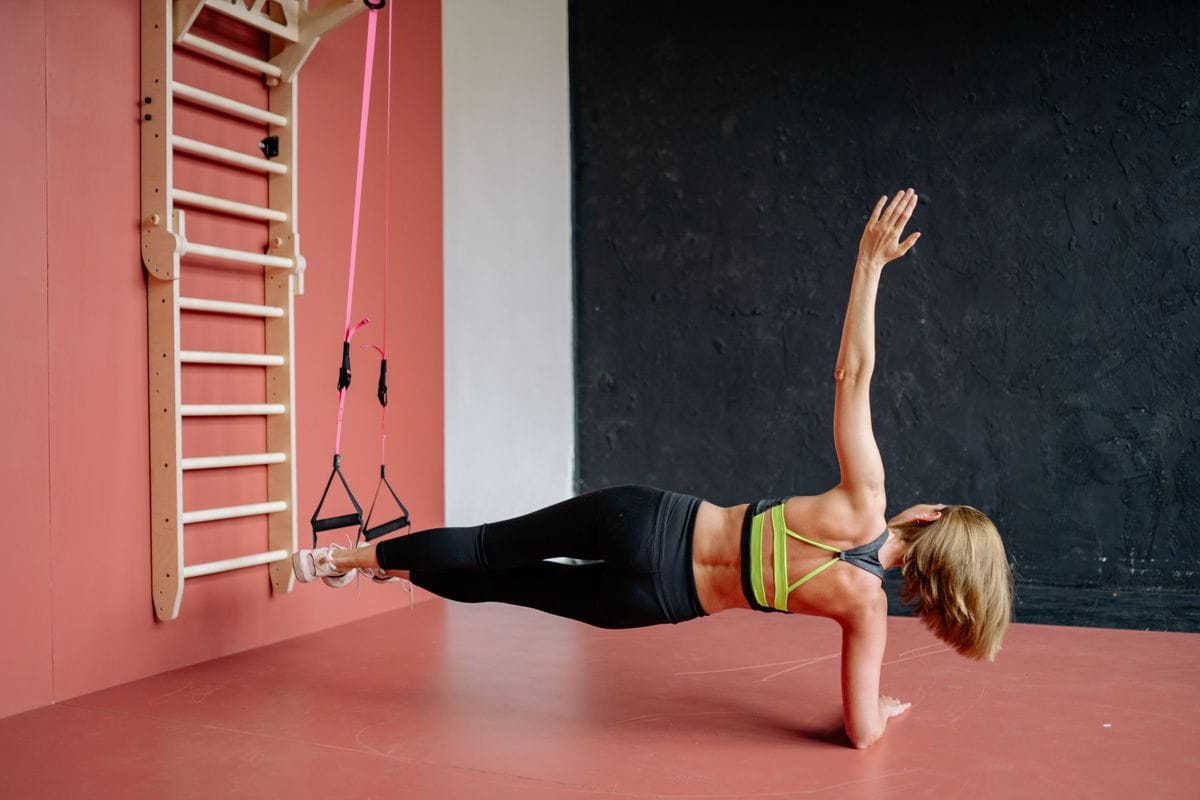
Side Planks Exercise: Execution Standards
- Lie on your side, elbow directly under your shoulder, forearm flat on the mat pointing forward.
- Stack your feet, or place the top foot slightly in front for balance on your first sessions.
- Brace your trunk and drive your hips up until your body forms one straight line from head to heels.
- Push the floor away through your forearm — your shoulder stays tall, never sinking toward your ear.
- Breathe steadily. Short, calm breaths — never a held breath.
- Hold for the prescribed time, lower your hips under control, then switch sides. That is one set.
200+ FCS Combat Application
In the 200+ FCS roadmap, Side Plank belongs to Phase 1.1 (Strength & Conditioning) as the lateral-core stabilizer. The obliques and quadratus lumborum are what keep your posture when a round kick lands on your guard, what let you frame off the bottom without folding, and what transfer hip drive into upper-body strikes. A trunk that resists side-bending is a trunk that stays in the fight.
How to Structure Your Side Plank Training
Program Side Plank in the main block of your session, after the warm-up: 3 sets of 20–30 seconds per side, resting 30–60 seconds between sides. The clock is the training variable here — add five seconds per week, not five variations. When a 45-second hold per side is calm and straight, move to the variations below rather than chasing two-minute holds.
Common Mistakes
- Sagging hips. The moment your hips dip, the obliques clock out and the lower back clocks in. A shorter hold in a straight line beats a long sag.
- Rolling the top shoulder forward. The chest stays open and stacked — shoulders in one vertical line, like your torso is between two panes of glass.
- Holding your breath. A plank you cannot breathe through is a plank you cannot use. Breathe behind the brace.
- Cranking the neck. Gaze forward, head in line with the spine. Your neck is riding along, not driving.
Safety Notes
- Stack the working elbow directly under the shoulder — too far forward or back loads the joint instead of the muscles.
- Use a folded towel under the elbow if the floor is hard; the point of the drill is the trunk, not elbow pain.
- Drop to the knees-down version (below) the moment your straight-line form breaks — form first, duration second.
- Stop if you feel sharp shoulder pain; a deep muscle burn is the drill, joint pain is not.
Coaching cue: “Elbow under shoulder, hips up, one straight line. Push the floor away and breathe behind the brace — tall shoulder, quiet neck.”
Benefits
As part of the broader 200+ FCS exercise library, this drill belongs to the plank family, built on isometric core strength while targeting the specific demands of the Strength & Conditioning phase. It trains the lateral trunk that front planks miss — the muscles that resist collapse sideways, protect the spine under uneven loads, and steady every rotational strike.
From a logistics standpoint, no equipment and no training partner are required, so it can be trained entirely alone — a mat’s worth of floor is the whole setup.
That combination of low logistical overhead and clear technical standards is exactly why this drill earns a permanent spot in the Gooart Space 200+ FCS system rather than being a one-off novelty movement: it can be trained consistently, tracked over time, and progressed safely as your overall combat fitness improves.
Programming & Progression
In the 200+ FCS framework, Side Plank is programmed inside the main workout block of a session. Program it after the warm-up, when you have the most physical and mental capacity to hold strict technical standards under fatigue.
At the beginner level, prioritize clean technique over speed, load, or range of motion — the execution standards above exist precisely so that quality is never sacrificed for intensity.
As you progress, the natural next step is to increase the hold time first, then move through the variations below, but only once every second can be held to the standard described earlier on this page. Revisit the Common Mistakes and Safety Notes sections regularly, since fatigue is usually what causes technical standards to break down first.
Frequently Asked Questions
Is Side Plank suitable for beginners?
Side Plank is classified as beginner in the 200+ FCS system. Start with the knees-down version, hold ten to fifteen seconds per side, and build up weekly. The straight-line standard matters more than the stopwatch.
What equipment do I need for Side Plank?
Nothing beyond your bodyweight and a mat or folded towel under the elbow. No weights, no bench, no partner. Check the Equipment Kit and Setup fields listed on this page for the exact setup used at Gooart Space.
Where does Side Plank fit in a training session?
Side Plank belongs to the main workout block of the 200+ FCS session structure. Pair it with an anti-extension drill like Dead Bug for a complete core block, or use it to finish a session when the trunk still has honest work left.
Plank Side Variations: Knees, Feet, and Stars
Plank side progressions climb in this order: knees-down side plank (short lever), full side plank (the standard on this page), star side plank (top arm and top leg raised), and side plank with hip dips (dynamic reps). Earn each step with a calm 30-second hold before climbing. For the flexion-side partner to this drill, see our Oblique Workout page.
Related Exercises
You've read the standards — now train them. Book a 1-on-1 session at our Melaka studio and get your baseline mapped across all 7 FCS systems in your first hour.
Book Your First Session