

This guide breaks down the plank exercise with clear execution standards, programming, and common mistakes to avoid.
Table of Contents
Part of the 200+ Functional Combat System (FCS), Plank is an intermediate strength and conditioning drill, working primarily the anterior core, rotational core, posterior chain and upper push. It is programmed as a cool-down and recovery element, trained solo and on mats. Equipment needed: Yoga/Exercise Mat.
Plank Execution Standards
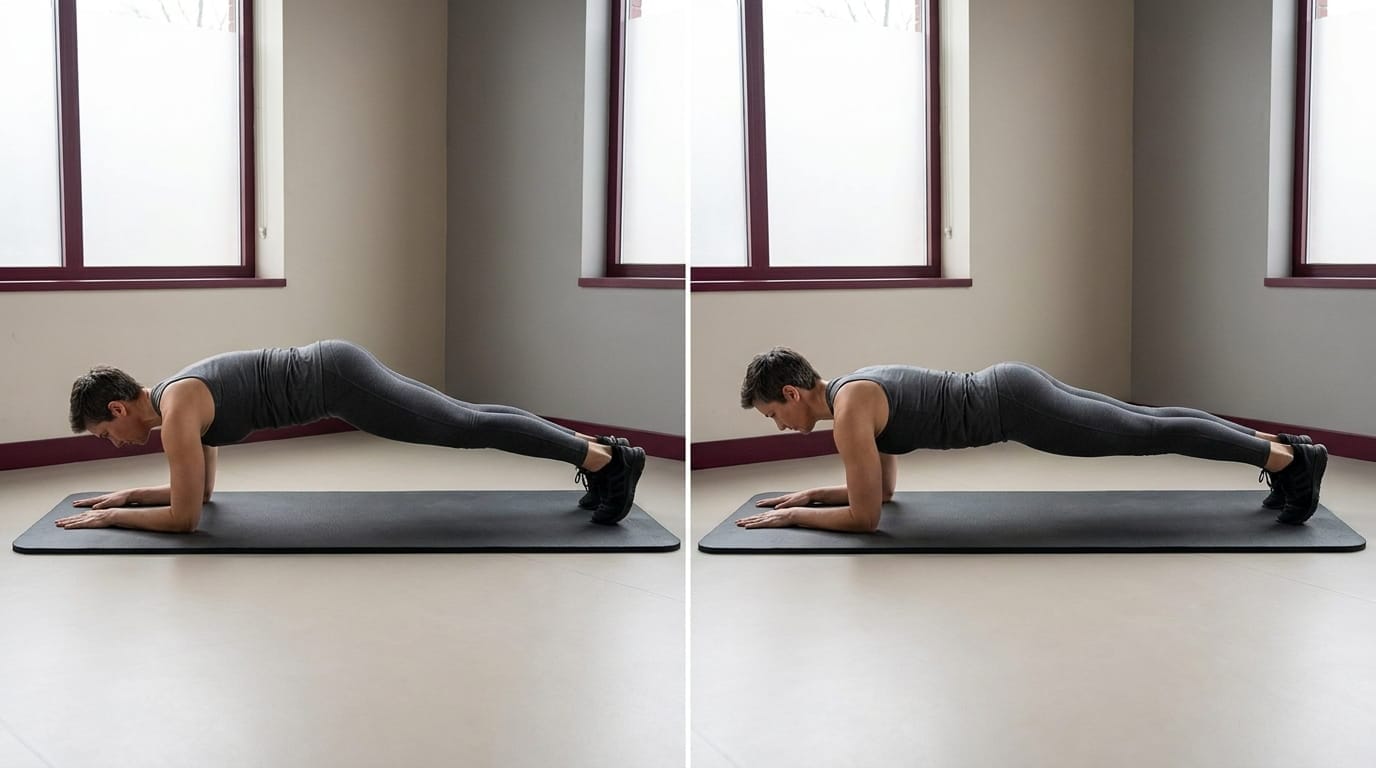
- Imagine a straight rod running from your head to your heels.
- Squeeze your glutes and don’t let the rod bend at the hips.
200+ FCS Combat Application
Within the 200+ FCS system, Plank sits in Phase 1.1 (Block A: High-Threshold Isometric Core Resistance). It builds the physical engine that every striking and grappling skill relies on: force you can produce, absorb, and repeat under fatigue. The strength and conditioning you develop here transfers directly into heavier hands, stronger clinch control, and a base that does not collapse under pressure. The primary physical targets are the anterior core, rotational core, posterior chain and upper push.
How to Structure Your Plank Training
Place Plank at the end of your session as cool-down and recovery work: 1–2 relaxed rounds of 2–3 minutes at low intensity, prioritising breathing, control, and range of motion while the heart rate comes back down. Watch the reference video on this page first, then match your reps to that standard.
Common Mistakes
- Letting the core disengage so the lower back absorbs the work
- Cutting range of motion short as fatigue builds
- Holding the breath instead of matching breathing to effort
- Adding intensity every session without planned recovery
Safety Notes
- Use a mat with adequate grip and thickness for the drill; a sliding mat is worse than no mat.
- Stop the set if sharp pain, dizziness, or loss of control appears — technical quality is the safety system.
Coaching cue: “Imagine a straight rod running from your head to your heels. Squeeze your glutes and don’t let the rod bend at the hips.”
Plank Exercise Benefits
The main plank exercise benefits are as part of the broader 200+ FCS exercise library, this movement builds on core strength training principles while targeting the specific demands of the Strength & Conditioning phase. In terms of difficulty, this is best suited to athletes who already have the underlying fundamentals in place.
From a logistics standpoint, no training partner is required, so it can be trained entirely alone, and in terms of kit it requires only minimal, pocket-sized equipment.
That combination of low logistical overhead and clear technical standards is exactly why this drill earns a permanent spot in the Gooart Space 200+ FCS system rather than being a one-off novelty movement: it can be trained consistently, tracked over time, and progressed safely as your overall combat fitness improves.
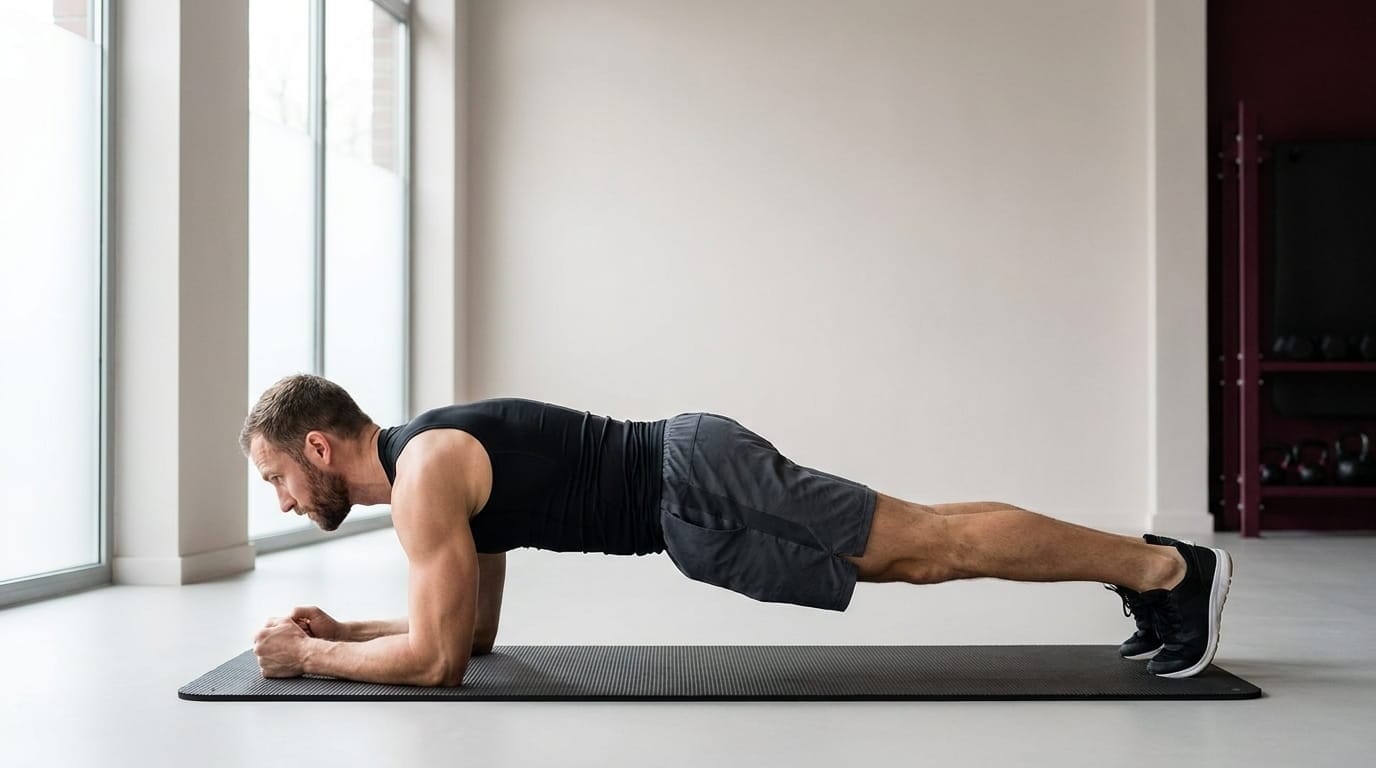
The main plank exercise benefits go far beyond “a stronger stomach.” As a high-threshold isometric hold, the plank trains the exact qualities that transfer into striking, grappling, and daily movement. Here are the seven that matter most:
- Core stability under pressure — The plank builds isometric strength across the anterior and rotational core, teaching your midline to resist collapse. In combat sports, this is the difference between a guard that holds and one that folds the moment you absorb a body shot.
- Lower-back endurance — By loading the posterior chain in a neutral position, planks condition the muscles that protect your lumbar spine — reducing the lower-back fatigue that shows up in long rounds and long workdays alike.
- Better posture and spinal alignment — Holding a true straight line from head to heels builds the postural awareness most desk-bound adults have lost. Over time, that neutral-spine position becomes your default, not just your gym position.
- A stronger striking base — Power starts at the ground and travels through the core. A rigid, well-braced midline lets force transfer cleanly from your hips into your punches, kicks, and clinch work instead of leaking out at the waist.
- Shoulder and scapular strength — The forearm support position keeps your shoulders and upper back under constant load, strengthening the stabilizers that keep your guard up and your shoulders healthy through high-volume striking.
- Breath control under tension — Learning to breathe steadily while fully braced is foundational combat conditioning. The plank is the simplest place to practice it before you need it under real physical stress.
- Trainable anywhere, progress forever — No partner, no gym, one mat. That low barrier means you can train it consistently, track your holds over time, and progress from basic holds to harder variations as your overall combat fitness improves.
Together, these plank exercise benefits are why the plank earns a permanent place in the Gooart Space 200+ FCS system — it is simple to start, hard to master, and it pays out in every other movement you train.
Programming & Progression
In the 200+ FCS framework, Plank is programmed inside the cool-down and recovery phase of a session. Use it at the end of the session to bring intensity back down, reinforce quality movement patterns, and support recovery for the next training day.
At the intermediate level, prioritize clean technique over speed, load, or range of motion — the execution standards above exist precisely so that quality is never sacrificed for intensity.
As you progress, the natural next step is to increase either the volume (extra sets, rounds, or reps), the resistance or speed, or the complexity of the movement itself, but only once every rep can be performed to the standard described earlier on this page. Revisit the Common Mistakes and Safety Notes sections regularly, since fatigue is usually what causes technical standards to break down first.
Frequently Asked Questions
Is Plank suitable for beginners?
Plank is classified as intermediate in the 200+ FCS system. In practice, this is best suited to athletes who already have the underlying fundamentals in place, and it is best coached with strict attention to the execution standards above before adding speed, load, or resistance.
What equipment do I need for Plank?
This drill requires only minimal, pocket-sized equipment, and no training partner is required, so it can be trained entirely alone. Check the Equipment Kit and Setup fields listed on this page for the exact gear used at Gooart Space.
Where does Plank fit in a training session?
Plank belongs to the cool-down and recovery phase of the 200+ FCS session structure. Use it at the end of the session to bring intensity back down, reinforce quality movement patterns, and support recovery for the next training day.
Related Exercises
You've read the standards — now train them. Book a 1-on-1 session at our Melaka studio and get your baseline mapped across all 7 FCS systems in your first hour.
Book Your First Session