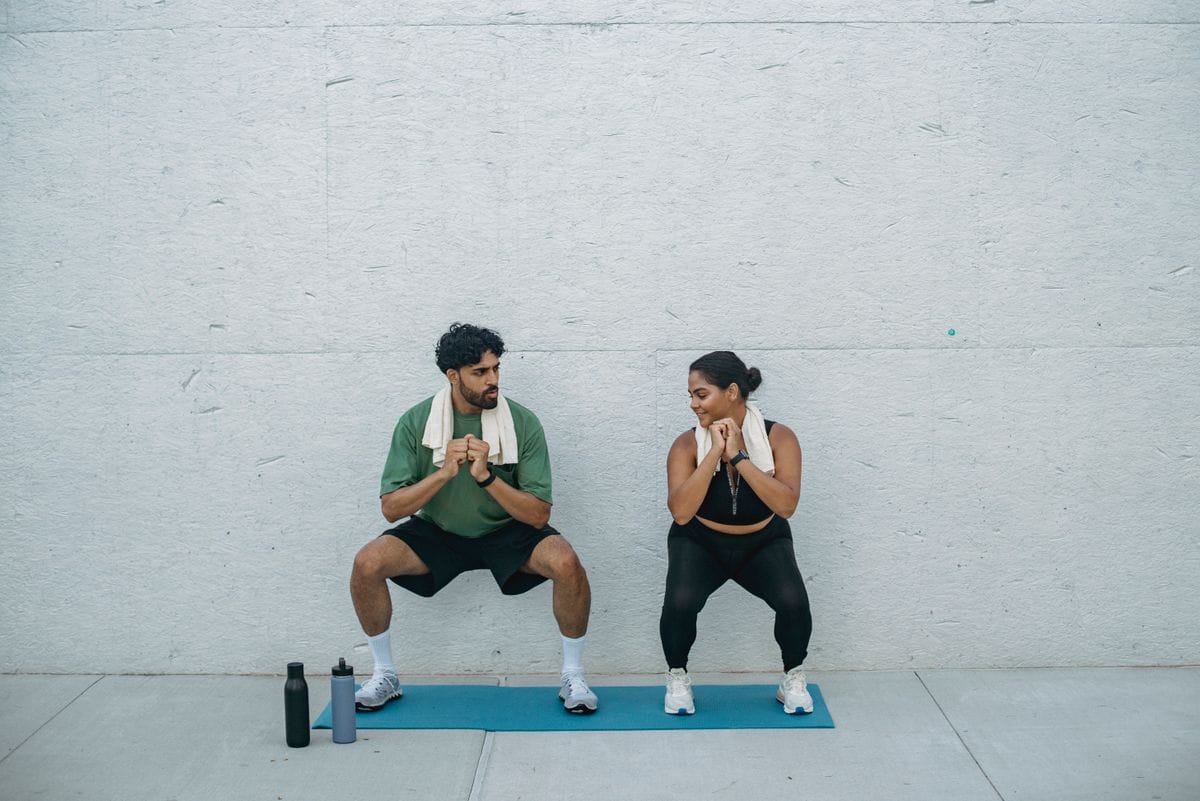

The wall sit is the simplest test of leg endurance in existence: back glued to a wall, legs bent into a perfect 90-degree chair, and nothing to do but breathe and hold. This wall sit exercise builds isometric strength in the quads, glutes, and deep stabilizers — with zero equipment beyond a flat wall.
目录
Wall Sit Execution Standards
The wall sit progresses through four levels, from finding the wall to owning the burn.
- Level 1: The Wall. Stand with your back against a flat wall, feet shoulder-width apart. Press your hips, lower back, and shoulders into the wall at the same time, then walk your feet out in front of you.
- Level 2: The Chair. Slide down the wall until your hips and knees both sit at exactly 90 degrees — thighs parallel to the floor, shins vertical, knees stacked over ankles. This is the perfect chair; higher is a regression, not a rep.
- Level 3: The Glue. Keep the entire back glued to the wall — no gap behind the lower back, no shoulders peeling forward. Drive your weight through the heels and take your hands off your thighs: cross them at your chest or rest them on your hips.
- The Rhythm. Breathe steadily and fight the burn in your quads without shifting, fidgeting, or creeping upward. The hold ends when form breaks — not when discomfort begins.
200+ FCS 战斗应用
As the anchor isometric leg exercise of Block A (High-Threshold Isometric Core Resistance), the wall sit trains the one quality no fighter can fake: a stance that holds its height under fatigue. Legs that endure at 90 degrees keep their level in round three, when tired fighters stand up tall and get countered.
The hold also wires the posterior chain and lateral core to brace while the legs scream — the same demand as riding out a clinch or checking a kick without collapsing. It is the static contract behind every dynamic pattern: what the cossack squat loads side to side, the wall sit locks in place.
Its Cool Down / Recovery slot is deliberate. Holding a perfect chair on exhausted legs — right after a 打空拳训练 or the main strength block — teaches the nervous system to keep structure when everything wants to fold.
How to Structure Your Wall Sit
A complete wall sit block at Gooart Space follows the 200+ FCS cool-down structure: 2 to 3 holds of 30–45 seconds each, with 30–45 seconds of standing rest between holds.
Hold 1 is the calibration hold — find the true 90-degree chair and memorize the position. Hold 2 goes to the full target time at strict depth. Hold 3 (optional, for advanced athletes) extends toward 60 seconds, or upgrades the challenge: hands behind the head, or slow single-leg extensions while the chair stays level.
End every hold on your terms: push through the heels and slide up the wall before form breaks. A shorter, perfect chair beats a long, creeping one.
Common Mistakes in This Wall Sit Exercise
- Sitting above parallel. Hips higher than knees turn the hold into a lean, not a chair. 解决方法: Slide down until thighs are truly parallel — mark the height on the wall if needed.
- Knees drifting past the toes. Feet too close to the wall load the knees instead of the quads. 解决方法: Walk the feet out until shins are vertical and knees stack over ankles.
- Lower back peeling off the wall. An arched gap leaks the brace the hold exists to build. 解决方法: Press hips, lower back, and shoulders into the wall as one piece before sliding down.
- Hands pushing on the thighs. Arms quietly steal the load from the legs. 解决方法: Cross the arms at the chest or place hands on hips — the legs do all the work.
- Weight rolling onto the toes. Heels floating shift the stress to the knees and calves. 解决方法: Drive through the heels — you should be able to wiggle your toes at any moment.
- Holding your breath. Breath-holding spikes tension and ends the hold early. 解决方法: Breathe on a steady count — in for three, out for three — for the entire hold.
安全注意事项
- Choose a solid, non-slip surface: A flat wall and grippy floor keep the chair from sliding — avoid glossy tiles in socks.
- Warm up before deep holds: Even in a cool-down slot, ease into the first hold at a higher angle before committing to 90 degrees.
- Respect the knees: The burn belongs in the quads, not the joint — sharp or pinching knee pain means the angle or foot position is wrong.
- Scale the hold: If 90 degrees breaks form, hold at a higher angle or shorter time and progress gradually — depth first, duration second.
- Stop conditions: Sharp knee pain, numbness or tingling in the legs, a lower back that peels off the wall, or uncontrollable trembling that shifts your position mean slide up and end the hold — quality of position always beats seconds on the clock.
Coaching cue: “Form a perfect 90-degree chair with your legs. Keep your back glued to the wall and fight the burn in your quads.”
益处
As part of the broader 200+ FCS exercise library, this movement builds on core strength training principles while targeting the specific demands of the Strength & Conditioning phase. In terms of difficulty, this is best suited to athletes who already have the underlying fundamentals in place.
From a logistics standpoint, no training partner is required, so it can be trained entirely alone, and in terms of kit it requires no equipment at all, making it a true anywhere, anytime movement.
That combination of low logistical overhead and clear technical standards is exactly why this drill earns a permanent spot in the Gooart Space 200+ FCS system rather than being a one-off novelty movement: it can be trained consistently, tracked over time, and progressed safely as your overall combat fitness improves.
Programming & Progression
In the 200+ FCS framework, Wall Sit is programmed inside the cool-down and recovery phase of a session. Use it at the end of the session to bring intensity back down, reinforce quality movement patterns, and support recovery for the next training day.
At the intermediate level, prioritize clean technique over speed, load, or range of motion — the execution standards above exist precisely so that quality is never sacrificed for intensity.
As you progress, the natural next step is to increase either the volume (extra sets, rounds, or reps), the resistance or speed, or the complexity of the movement itself, but only once every rep can be performed to the standard described earlier on this page. Revisit the Common Mistakes and Safety Notes sections regularly, since fatigue is usually what causes technical standards to break down first.
Frequently Asked Questions
Is Wall Sit suitable for beginners?
Wall Sit is classified as intermediate in the 200+ FCS system. In practice, this is best suited to athletes who already have the underlying fundamentals in place, and it is best coached with strict attention to the execution standards above before adding speed, load, or resistance.
What equipment do I need for Wall Sit?
This drill requires no equipment at all, making it a true anywhere, anytime movement, and no training partner is required, so it can be trained entirely alone. Check the Equipment Kit and Setup fields listed on this page for the exact gear used at Gooart Space.
Where does Wall Sit fit in a training session?
Wall Sit belongs to the cool-down and recovery phase of the 200+ FCS session structure. Use it at the end of the session to bring intensity back down, reinforce quality movement patterns, and support recovery for the next training day.
Isometric Leg Exercise
Looking for “isometric leg exercise”? Wall Sit covers this directly, using the standards and safety notes already outlined on this page.
Related Exercises
您已经阅读了相关标准——现在就来培训他们吧。预约我们在马六甲工作室的一对一课程,在第一小时内即可针对您所使用的全部7个FCS系统完成基准评估。.
预约您的首次课程